
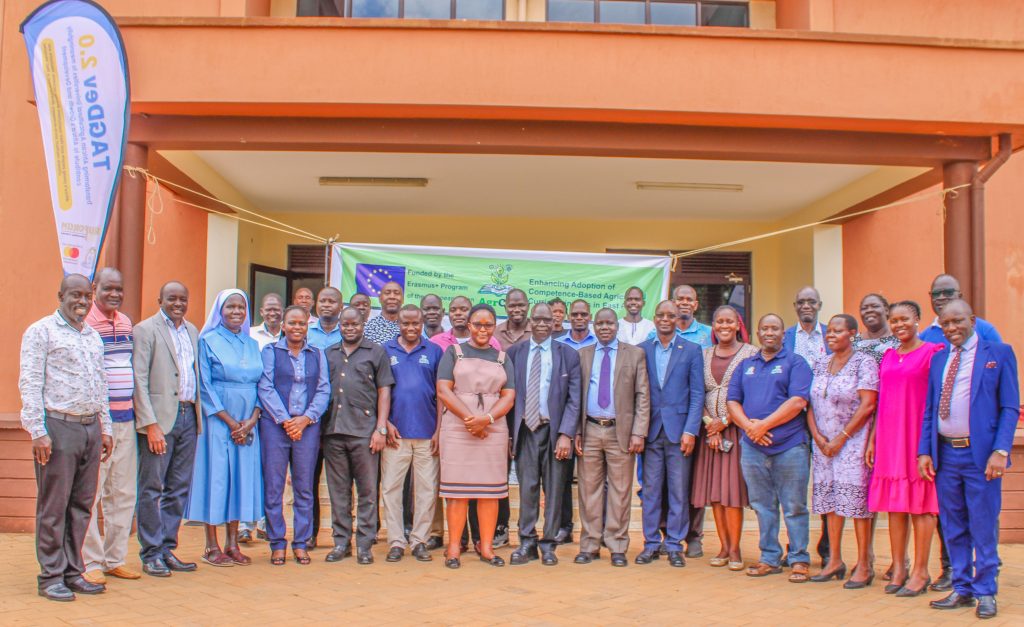
Gulu University, in collaboration with key national and regional partners, successfully hosted a four-day Competence-Based Education and Training (CBET) retooling workshop from 13th to 16th April 2026 at the University’s New Library.
The training was organized under the TAGDev 2.0 Program, brought together academic leaders, CBC experts, and stakeholders from Gulu University, Busitema University, Muni University and Bishop Stuart University.
The workshop aimed to strengthen institutional capacity in the design, implementation, and assessment of competence-based curricula, in preparation for Uganda’s transition to competence-based higher education by 2027.
Day 1: Setting the Foundation for Transformative Education
The training commenced with opening remarks from university leadership and partners, setting the stage for transformative higher education.
Participants were introduced to the core concept of competence-based education summarized as:
“Competence = Knowledge (Know) + Skills (Do) + Values (Be)”
Sessions focused on:
- Fundamentals of Competence-Based Education (CBE)
- Alignment with national education policies and frameworks
- The need to shift from knowledge-based to competence-driven learning
The day established a shared understanding of CBET as a pathway to producing work-ready, innovative, and socially responsive graduates.
Day 2: Policy Frameworks and Institutional Alignment
Day 2 focused on key competence frameworks and curriculum policies guiding higher education in Uganda.
Led by the Academic Registrar, Dr. Jerry Bagaya, participants explored:
- Institutional policies and regulatory frameworks at Gulu University
- National standards, including CBET minimum requirements for Higher Education Institutions
- Quality assurance frameworks and accreditation processes
A major highlight of the day was the official launch of the Gulu University CBE Taskforce by the Deputy Vice Chancellor (Academic Affairs), Prof. David Okello Owiny.
The taskforce is expected to spearhead curriculum transformation and guide the University’s transition to CBET.
Day 3: From Frameworks to Practice
Day 3 marked a shift from theory to hands-on implementation.
Participants engaged in practical sessions on:
- Developing minimum curriculum benchmarks
- Designing assessment frameworks (formative and summative)
- Creating assessment blueprints and rubrics
- Understanding notional hours and curriculum structure
- Strengthening industry collaboration frameworks
Group work and presentations allowed participants to apply concepts directly, reinforcing the practical nature of competence-based education.
Day 4: National Perspective and Way Forward
The final day brought a strong national policy perspective, with a keynote presentation by the Commissioner for Higher Education and Training, Mr. Ochira John Pakony, from the Ministry of Education and Sports.
His presentation focused on readiness, support systems, and policy alignment for CBET, emphasizing that:
- The transition to CBET is a national priority to be implemented by 2027
- Institutions may not be fully ready but must begin implementation and improve progressively
- Successful implementation requires system-wide alignment—including curriculum, leadership, infrastructure, and governance
- Mindset change is critical to overcoming resistance within institutions
- Strong industry linkages are essential to enhance graduate employability
- Capacity building must continue, with institutions cascading knowledge internally
He further highlighted the risks of not adopting CBET, including producing graduates who do not meet labor market demands and declining public confidence in higher education.
Key Outcomes of the Training
The training achieved several important outcomes:
- Strengthened capacity of academic staff in CBET design, delivery, and assessment
- Development of practical tools including curriculum benchmarks and assessment frameworks
- Enhanced understanding of national and institutional policy alignment
- Strengthened collaboration among participating universities and stakeholders
- Establishment of the Gulu University CBE Taskforce to drive implementation
Role of TAGDev 2.0
Through the Mastercard Foundation-supported TAGDev 2.0 Program, this training contributes to:
- Building institutional capacity for transformative higher education
- Promoting market-responsive, competence-based learning systems
- Strengthening partnerships between academia, government, and the world of work
- Supporting the development of skilled, employable, and entrepreneurial graduates
Acknowledgement
TAGDev 2.0 Program extends its sincere appreciation to the university management for their strong support and leadership in making this training a success. Appreciation also goes to all facilitators, participants, and partners for their active engagement and commitment throughout the four days.
Conclusion
The CBET retooling workshop marks a significant milestone in Gulu University’s journey toward competence-based education. While the training has concluded, the focus now shifts to implementation, ensuring that the knowledge and skills gained translate into meaningful curriculum transformation.
